Kengo Kuma's "Floating Lantern" Breaks Ground: What Mirai's $85M Loan Tells Miami Investor/s
Most coverage of Mirai Design District frames its groundbreaking as an architecture story — Kengo Kuma's first mixed-use building in the United States finally rising in Miami. This analysis takes a different angle: we read the $85 million construction loan behind it as a leading indicator. When a boutique office-and-retail project lands eight figures in construction debt and breaks ground after a two-year delay, it's telling you something concrete about where capital believes the Design District Miami corridor is headed — and that signal matters as much to a luxury condo investor as it does to an office tenant. Here's how to read it.
What Mirai Design District Actually Is
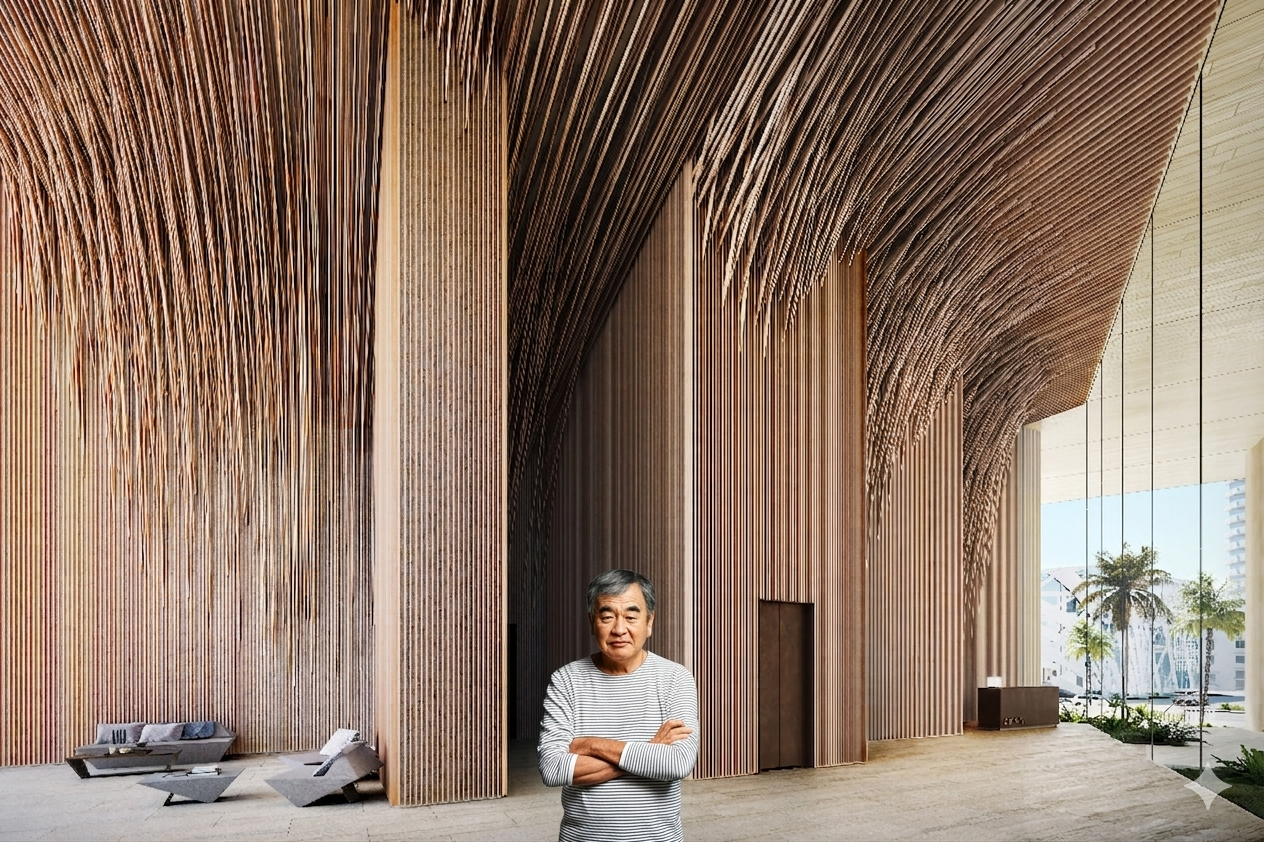
Let's clear up a point that gets garbled constantly: Mirai is not a residential luxury tower. It is a mixed-use office and retail project at 4218 Northeast Second Avenue, in the heart of the Design District. The design calls for a three-story building with roughly 41,000 square feet of Class A office space and 16,000 square feet dedicated to retail, restaurant, and hospitality uses, plus a 2,000-square-foot standalone house conceived as a sculptural centerpiece.
The "floating lantern" name comes from Kuma's design language — a transparent ground floor, a layered facade, and a central garden meant to blend architecture with nature and public space. (For the record: Kuma is also the architect behind Aman Residences Miami Beach, the 18-story luxury condominium under construction in the Faena District. That's a separate building in a separate neighborhood — Mirai is his first U.S. mixed-use project.) Completion is now slated for 2028.
Why the $85 Million Construction Loan Is the Real Headline
In early June 2026, developers Lionheart Capital, Leviathan Development, Well Duo, and the Lane Organization secured an $85 million construction loan from Chicago-based Monroe Capital and broke ground. The financing came together with help from Well Duo and Berkadia, and closed with a lender that already knew the team from prior deals.
Why should an investor care about a commercial loan? Because construction debt is a vote of confidence with real money attached. The project had been stalled — originally expected to start in summer 2024 and finish by the end of 2025 — held up by design revisions, a long entitlement process, and the pursuit of a still-unnamed marquee tenant. The fact that capital ultimately committed, after that delay, says lenders are comfortable underwriting boutique space in this micro-market. In a higher-rate environment, that comfort is one of the cleaner reads you'll get on an asset class.
How a Boutique Office Project Signals Residential Demand
Here's the connection to Miami real estate investment that most readers miss. The developers are explicitly betting that the steady migration of financial firms and creative businesses to Miami will drive demand for small, design-forward office space — the kind sought by family offices, small and midsize funds, and design-focused companies — rather than the larger floorplates found in Wynwood or the Brickell Financial District.
Why does that matter to a condo buyer? Because live-work-invest corridors form in a predictable sequence: luxury retail anchors the neighborhood, boutique office follows the money that wants to be near it, and residential demand compounds on top of both. The Design District has already completed the first step as one of the country's top luxury retail destinations. Mirai is the second step. And the third is already visible: a recent The Real Deal analysis found close to 1,000 residential units in the Design District pipeline. For anyone tracking pre-construction condos South Florida, a commercial groundbreaking like this is the kind of leading signal that tends to precede residential price strength.
How Much Land Costs Here — and Why That's the Real Moat
Concrete numbers tell the scarcity story better than any rendering. Lionheart acquired the remaining interest in the 4218 Northeast Second Avenue property in October 2023 for $5.5 million, and the broader development site — which also includes 4200 and 4240 Northeast Second Avenue — was assembled after Miami Design District Associates (Craig Robins' Dacra, L Catterton Real Estate, and Brookfield Properties) sold those adjacent lots for $20 million.
The takeaway isn't the dollar figures themselves; it's who controls the land. Developable square footage in the Design District is concentrated in very few hands, which is precisely what has limited new supply for years. That constraint is the corridor's economic moat — it's what supports pricing on both the commercial and residential sides over the long run. Lionheart's stated plan to hold Mirai for at least a decade reflects exactly that thesis.
What This Means for Real Estate Market Trends Florida 2026
Mirai fits a pattern that's defining real estate market trends Florida 2026: capital is rewarding scarce, design-authored, location-locked product over generic square footage. The same logic driving boutique office in the Design District is driving branded residences on the beach and limited-supply condos near transit. The common thread is that buyers — whether they're leasing a 3,000-square-foot office or buying a $4 million condo — increasingly pay a premium for irreplaceable location plus a credible design and brand story.
The Inbest Partners Take
From our work in this market, the detail we'd flag to an investor is the corridor itself. Northeast Second Avenue is the spine the Design District is being built along, and the blocks closest to the existing luxury-retail core behave very differently from those a few hundred feet out. A boutique office building anchored by a high-profile (if still confidential) tenant tends to pull foot traffic, dining, and ultimately residential interest toward it. If you're evaluating Design District condos in the pipeline, watch which projects sit within easy walking distance of Mirai once that tenant is announced — proximity to a live commercial anchor is one of the most reliable value drivers we see on the ground.
Frequently Asked Questions (FAQ)
Is Mirai Design District a residential condo project? No. Mirai is a mixed-use office and retail building — about 41,000 square feet of Class A office and 16,000 square feet of retail and hospitality space. The Design District's residential wave is a separate set of projects, with roughly 1,000 units reported in the pipeline.
When will Mirai Design District be completed? Completion is targeted for 2028. The project broke ground in June 2026 after delays tied to design revisions, entitlements, and securing an anchor tenant.
Who provided the financing for Mirai? The development team secured an $85 million construction loan from Chicago-based Monroe Capital, arranged with help from Well Duo and Berkadia.